
Watch this Extremely Effective Right Wing Propaganda Video that Is Effective Primarily Because the Left Wrongly Says that Ordinary Whites Benefit from Racial Discrimination Against Non-Whites
Egalitarians, in contrast to Leftists, show that racial discrimination against non-whites HARMS, not benefits, working class whites.

Please restack this if you want more people to see it.
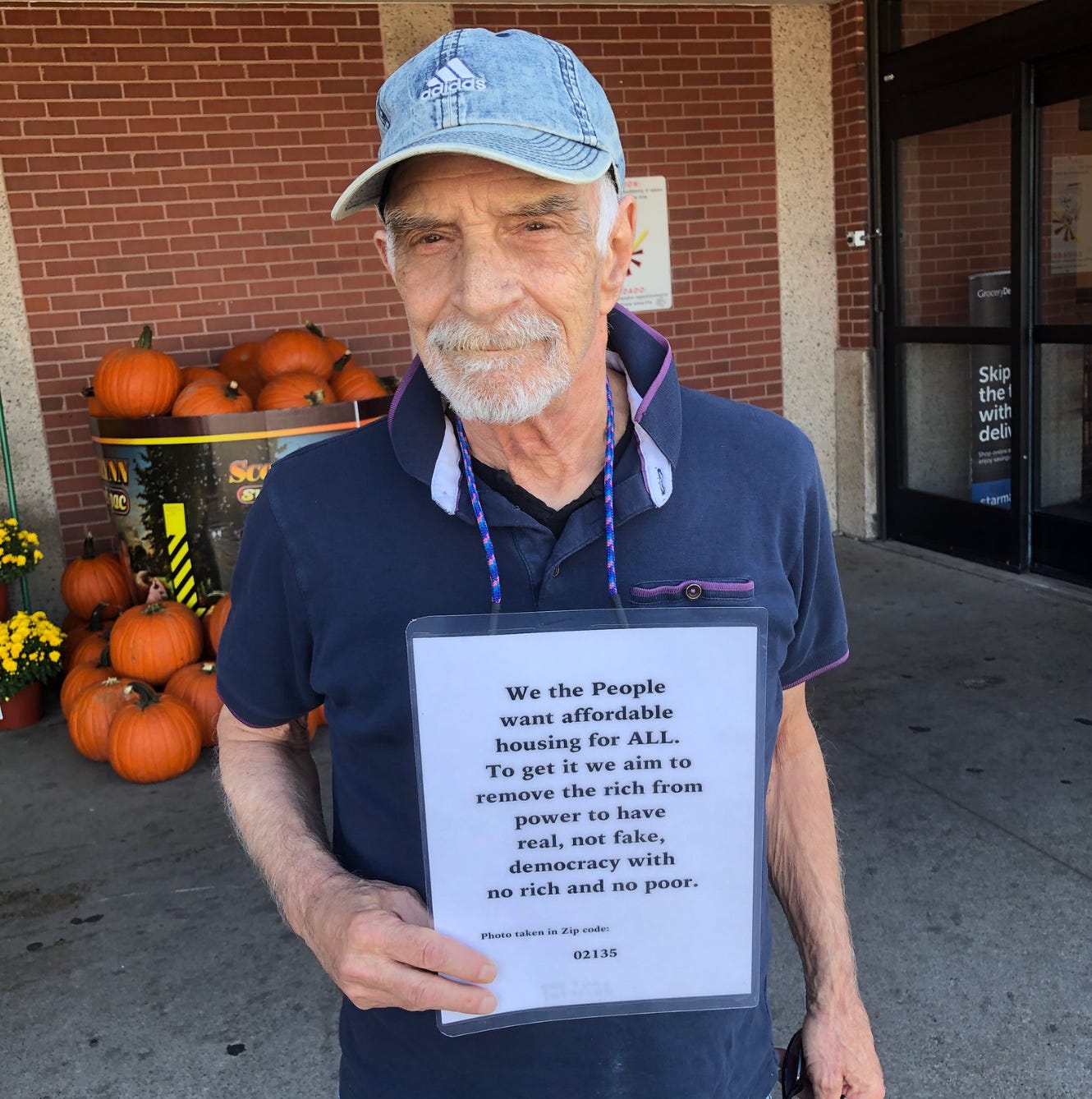
The ruling class works very hard, and very cleverly, to turn egalitarians like this wonderful egalitarian man against each other along race lines. Egalitarians refute the lies that the ruling class uses to do this. Some of these lies, however, go un-refuted by both the Left and the Right. Go here to see 500+ photos of more wonderful egalitarians in my postal zip code.
I call to your attention this TicTok video (it’s at the top of the linked Substack post that contains it) of a woman making the argument—quite persuasively for many people I have no doubt—that a) the powers that be are wrongly teaching children that the most important thing for them to know about the world is that white people are the evil oppressors of non-whites; and b) that it’s wrong to be very concerned with the concept of oppression because there is so much more about our society that is far more important. I strongly suggest you watch this video to see how powerful it is.
Here’s a screenshot of it so you know for sure what video I’m talking about:
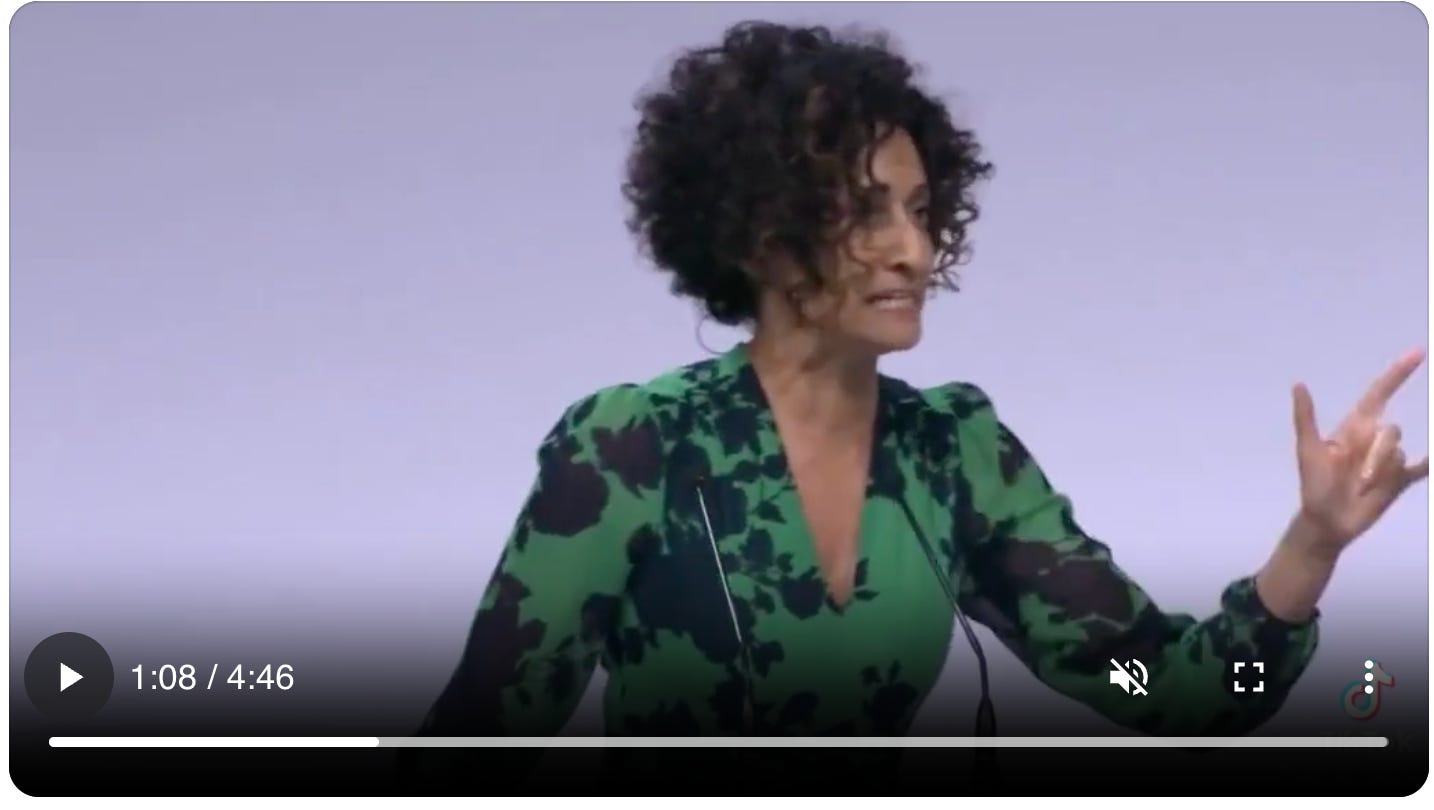
People who agree with this woman are generally characterized as “right wing.”
The way that far too many Leftists disagree with this woman is by saying a) that it is true that whites oppress non-whites and so it is not wrong for the powers-that-be to tell this to children; and b) that oppression is indeed a very important concern.
In the United States a lot of white working class parents of children in the public school system are, like the woman in the video, angry—justifiably so!—that their children are being taught that they and their white parents and grandparents, etc., are/were the racist oppressors of non-whites. They are taught this in the context of lessons, now known as Critical Race Theory (CRT), about U.S. history such as the fact of enslavement (chattel slavery) of blacks and the fact of subsequent discrimination against blacks in law known as Jim Crow. What the white parents are angry at is not the teaching of the facts of chattel slavery and Jim Crow but rather the wrongful teaching (that CRT affirms) that these racist practices were for the purpose of, and succeeded in, making the lives of ordinary whites better at the expense of non-whites, and hence whites in the past and today are indeed—supposedly!—the racist oppressors of non-whites regardless of whether they did or currently do wish to be so or not.
These white parents have good reason to be angry! Their children are in fact being taught a lie, that they are the racist oppressors of non-whites.
The fact of the matter is, as I spell out in great detail here and in the articles it links to under its title, and here specifically regarding CRT, racial discrimination against non-whites (which is still today very much a fact, as I discuss in detail here) has always HARMED, not benefited ordinary white people, that it is a way that the rich upper class has managed to oppress both non-whites and whites. Its purpose has been to destroy solidarity between white and non-white working class people, by fomenting mutual mistrust and resentment and fear between them, thereby enabling the rich upper class to oppress ALL races of working class people and get rich at the expense of all of them. White working class people’s lives are worse because of this, not better!
I have also written here and here how the ruling class uses the “whites benefit from racial discrimination against non-whites” lie to institute reverse racial discrimination for the purpose of pitting working class people against each other along race lines for divide-and-rule.
The problem with the Left is not that it is weak, but that it is WRONG
The left does not believe or say, never mind try to show persuasively as I do, that racial discrimination against non-whites HARMS, not benefits, working class whites. The Left thus agrees with the ruling class promotion of the phrase “white privilege,” which is all about asserting that ordinary whites benefit from (a “privilege” is by definition a benefit) racial discrimination against non-whites. If you disagree with me about this, then please read my above-linked article titled, “Is it a ‘Privilege’ Not to be Discriminated Against?”
The Left, mostly I suppose unwittingly as useful idiots, praises Affirmative Action and DEI without understanding that these programs were instituted by the ruling class to turn white working class people against non-whites, as I discussed in my above-linked article, “We Need THIS, Not Affirmative Action,” and in the articles it links to under its title.
Right wing propaganda would not be effective if most people understood the truth: that racial discrimination against non-whites HARMS, not benefits, working class whites.
Today, when white parents rightfully are angry at their children being taught the CRT lie that they and their parents and grandparents were/are racist oppressors of non-whites because they benefit(ed) from racial discrimination against non-whites, what does the Left do?
The Left attacks these parents by calling them racists! The Left wrongly says the parents are angry because, in their racism, they don’t want their children to learn about the historical facts of chattel slavery and Jim Crow. The Left, claiming to be speaking on behalf of non-whites, attacks white working class people. This is EXACTLY what the ruling class wants to happen. Exactly! It’s divide-and-rule.
Because of the Left, right wing videos like the one I have called your attention to, are effective. Because of the Left attacking them as racist oppressors, white working class people naturally agree with the woman in the right wing video who says the government is lying when it accuses them of being oppressors. Since they are being accused of being the oppressor, white working class people naturally agree with the woman in video who says oppression is a bogus concept.
Right wing propaganda denies the fact that ALL the have-nots (all races and ethnicities and nationalities) are treated like dirt by the wealthy upper ruling classes.
Right wing propaganda denies this fact in various ways. The woman in the video cited above denies it by denying that there is any oppression worth talking about at all, and that the ruling class talks about oppression only in order to wrongly blame whites for being oppressors.
Alternatively, some right wing propaganda is all about how the ONLY people who are truly oppressed (or whose oppression really matters) are whites, a.k.a. the indigenous people of Britain and so forth (here’s a video1 with this theme.)
Each of these right wing themes resonates with white working class people for obvious reasons: they know they are not oppressors, and they know they are oppressed. The only thing that would persuasively challenge the right-wing viewpoint (either one of them) is the egalitarian viewpoint that says ALL of the have-nots are oppressed by the wealthy upper ruling classes.
The ruling class knows this and it knows that the right-wing viewpoint prevents solidarity of ALL the have-nots, which is the only thing that seriously threatens the power of the rich. This is why the ruling class lets the right wing message be widely heard but works so hard to censor the egalitarian revolutionary message:
The person speaking in the video is Nick Griffin, once the leader of the British National Party and a member of the European parliament and known as a right-wing personality. Griffin is an interesting person, based on some videos I watched recently of him speaking. For example, he opposes the massive immigration into the UK on the true grounds that it harms white British working class people and he truthfully says (as the Left and establishment liberals and most right-wingers and the ruling class never do) that the REASON there is such massive immigration is because the British ruling class has worked to destroy the countries that the immigrants come from and the solution is to make the rulers stop destroying those countries (the same point I make here.)
Griffin advocates (in the video I link to above) that, among other action tactics, whites in Britain try to obtain social places where they are not bombarded with ruling class-promoted messages that implicitly demonize whites as oppressors. The Left would scream that Griffin is thereby a white supremacist. I think the actual issue raised by Griffin, however, is freedom of association, about which I have written here where I address the race issue in this connection.
Where Nick Griffin is very wrong, however, is in advocating nationalism and not working class solidarity; I have written about this in detail in my recent, “Beware of Nationalism, in the UK and Everywhere Else. Nationalism is how oppressors control and oppress the have-nots, in the UK and in Palestine and India and South Africa, and on and on.”
This a powerful AND valid argument!
Nauseating. First, I covered education in many states as a newspaper reporter. And, I taught as a substitute in many K12 distructs. You have zero idea how ludicrous you are thinking K12 is about teaching kiddos the truth, like the film 13th, or Exterminate All the Brutes, or the 1619 Project. Howard Zinn's People's History of the US is banned in many districts. WE CAN'T teach that, dude.
Here, amazing interview, again, try using this in many community colleges:
https://youtu.be/dIrxzoaotHw?si=Ru21U7RNc7cv07k7
Gerald Horne in High School? Where can you teach his work?
"To the extent that 1776 led to the resultant U.S., which came to captain the African Slave Trade—as London moved in an opposing direction toward a revolutionary abolition of this form of property—the much-celebrated revolt of the North American settlers can fairly be said to have eventuated as a counter-revolution of slavery."
Alabama Alaska Arkansas Florida Idah o Indiana Iowa Kansas Kentucky Louisiana Mississippi Missouri Montana Nebraska North Carolina North Dakota Ohio Oklahoma South Carolina South Dakota Tennessee Texas Utah West Virginia Wyoming?
No way, Jose.
In his book The Counter-Revolution of 1776, historian Gerald Horne challenges the traditional view of the American Revolution. He argues that it was not a progressive fight for freedom, but a conservative movement to protect the institution of slavery from growing British abolitionist sentiments.
Teaching the Jewish State of Rape and Torture and Starvation is a colonial WHITE apartheid state of interlopers and land thieves? In High School? College? Bullshit:
Over 37 U.S. states have officially adopted or recognized the International Holocaust Remembrance Alliance (IHRA) working definition of antisemitism.
+--+
Ya just don't get it.
+--+
Ya think I can teach Nick Estes in K12 where there is a heavy influence of Native Culture in the area? GIVE ME A BREAK. These books are verboten in your supposed great caring white-dominated school districts.
Water Protectors vs. Pipeline: The book details the protests against the Dakota Access Pipeline (DAPL). This pipeline was built to carry oil across the Missouri River, threatening the drinking water and sacred lands of the Standing Rock Sioux Tribe. The Concept of "Tiwahe": Estes uses the Dakota word tiwahe (which means "family" or "household") to describe how water protection is an act of caring for all living things. Think of it as a pebble dropped in a pond; one action ripples out to affect the entire community. The Long Tradition: The author shows that the Standing Rock camp was not an isolated event. It was a continuation of past struggles, such as the fight against the Pick-Sloan Plan in the 1940s and 1950s. That plan built large dams on the Missouri River that flooded Native lands. Decolonization: Estes argues that to heal our future, society must listen to Indigenous knowledge. Instead of treating the earth like a resource to extract for profit, we should treat it like a relative.
+--+
My old union:
"Let's be clear: critical race theory is not taught in elementary schools or high schools. It's a method of examination taught in law school and college that helps analyze whether systemic racism exists — and, in particular, whether it has an effect on law and public policy," Weingarten said. "But culture warriors are labeling any discussion of race, racism or discrimination as CRT to try to make it toxic. They are bullying teachers and trying to stop us from teaching students accurate history."
+--+
When Gloria Ladson-Billings set out in the 1990s to adapt critical race theory from law to education, she couldn’t have predicted that it would become the focus of heated school debates today.
Over the past couple years, the scrutiny of critical race theory — a theory she pioneered to help explain racial inequities in education — has become heavily politicized in school communities and by legislators. Along the way, it has also been grossly misunderstood and used as a lump term about many things that are not actually critical race theory, Ladson-Billings says.
“It's like if I hate it, it must be critical race theory,” Ladson-Billings says. “You know, that could be anything from any discussions about diversity or equity. And now it's spread into LGBTQA things. Talk about gender, then that's critical race theory. Social-emotional learning has now gotten lumped into it. And so it is fascinating to me how the term has been literally sucked of all of its meaning and has now become 'anything I don't like.'”
In this week’s Harvard EdCast, Ladson-Billings discusses how she pioneered critical race theory, the current politicization and tension around teaching about race in the classroom, and offers a path forward for educators eager to engage in work that deals with the truth about America’s history.
Enjoy:
https://www.gse.harvard.edu/ideas/edcast/22/02/state-critical-race-theory-education