

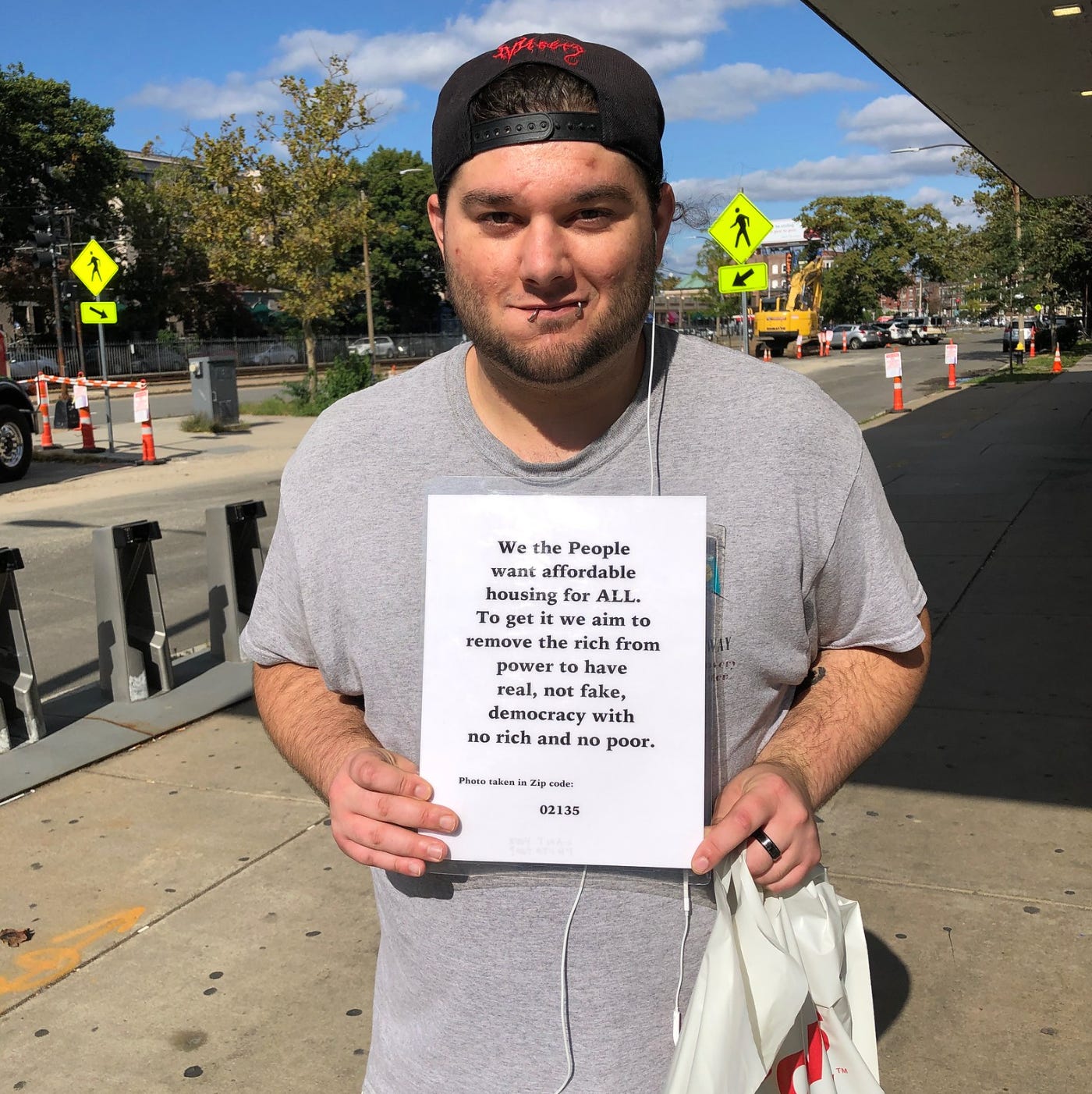
This wonderful egalitarian man, like billions of other egalitarians, wants changes in our society that would, I am sure, dramatically reduce the number of people who become self-harming drug users living on the street and the number of mentally ill people living on the street. Go here to see 500+ photos of more wonderful egalitarians in my postal zip code.
I am writing today in response to a Boston Globe article deploring conditions on the streets of Burlington, Vt. Here are some excerpts:
Aggressive panhandling, people shooting up in public, open drug sales, doorways and public parks full of those with nowhere to live, and an official laissez-faire attitude about all that antisocial behavior isn’t a great advertisement for the state’s flagship university when parents are college-shopping with their kids.
…
The approach that Letendre and many others say is not working is called harm reduction, which focuses on minimizing the negative health, social, and legal consequences associated with drug use. As proponents here like to say, harm reduction is about meeting people with care, not judgment.
In practical terms, that means the guy shooting up in a public park as kids walk by isn’t arrested, or even urged to move along. Instead, he’s given clean needles.
I am sure you have probably read similar newspaper article like this one. The conditions it describes are very widespread, in cities with both Republican and Democratic party mayors and outside the United States as well.
One of the comments to this article said the following, which I thought was interesting.
Not sure just enabling public drug use is “harm reduction”. In Vancouver, BC, where harm reduction helped save the city, it has three pillars. 1. Medically supervised safe injection sites, where users can receive clean equipment , have drugs checked for impurities that are dangerous, and safely use in a private space with help nearby in case they overdose or have another medical emergency. 2. Treatment so that anyone who wants to kick their habit can be quickly moved into treatment the moment they ask for it and while they are in the right mindset to do it. 3. Law enforcement is the third pillar. Once safe injection sites open, the police need to make it clear open drug activity is no longer wise. Using a combination of encouragement to get users into the safe injection sites and enforcement for those who will not go, as well as to reduce the ability of dealers to get new addicts hooked, the police play a crucial role. It should also be noted that none of this will do much to solve the problem without accompanying policies to reduce the mental health and social problems that encourage drug use to begin with.
Reading this comment sparked my curiosity about what was going on in Vancouver, BC and in the course of some Googling I came across this interesting academic article in the Harm Reduction Journal:
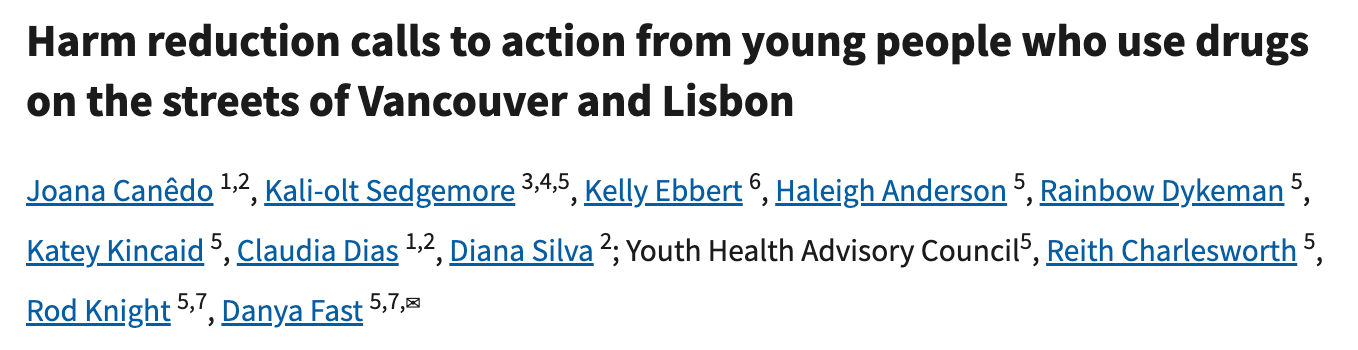
What especially makes this an interesting article is who the authors are; they write (after explaining that by YPWUD they mean “young people who use drugs (YPWUD; referring here to individuals between the ages of 14 and 29)”:
We are a group of community and academic researchers and activists working in Vancouver, Lisbon, and Pittsburgh. Most of us identify as YPWUD and have lived and living experience with the issues described in this comment. We make several calls to action to support the harm reduction needs of YPWUD in the context of street involvement in and beyond our settings.
The authors in the Abstract write:
We make several calls to action to support the harm reduction needs of YPWUD in the context of street involvement in and beyond our settings.
The authors in the article explain in this sentence what they mean by “street involvement”:
In particular, the needs of YPWUD in the context of unstable housing, homelessness, and ongoing poverty—a context which we summarize here as “street involvement”2 for the sake of brevity—are not being adequately met.
What is striking about this article is what it does NOT say.
Clearly the authors are aware of the immense importance of the “context of unstable housing, homelessness, and ongoing poverty.” Clearly the authors know that this context—class inequality!—drives the use of drugs. The authors tell us why YPWUD use drugs with these words:
We know that young people—even very young people—use drugs. For example, many of us, as well as the people we have encountered through our research and life experiences, started using drugs (and not just cannabis) between the ages of 10 and 12. Young people use drugs for a lot of different reasons. Drugs are a source of sociality, pleasure, and fun, as well as a means of navigating boredom, physical, psychological and emotional pain, trauma, and forms of historical and structural oppression along axes of race, class, gender, sexuality, and ability [19, 20]. YPWUD in the context of street involvement often use stimulants such as meth and crack cocaine (crack) in order to stay awake outside for long periods of time to protect themselves and their belongings and to generate income [21]. Drugs themselves can be forms of harm reduction and treatment. For example, YPWUD in Vancouver and Lisbon use cannabis to mediate their use of substances such as crack, meth, heroin, and fentanyl [22]. In Vancouver, some YPWUD use meth to stop using crack, heroin, and fentanyl [21]. Stimulants like meth and crack can also be a means of mediating the sedating effects of methadone and some psychotropic medications. All of these examples demonstrate how YPWUD often carefully regulate their substance use to achieve desired effects and affects [20].
I am sure the authors know that in the ABSENCE of the “context of unstable housing, homelessness, and ongoing poverty” there would be FAR less use of drugs.
And yet, in the concluding section of their article titled “Calls to Action,” consisting of twelve enumerated paragraphs, there is no mention of any action aimed at abolishing unstable housing, homelessness, and ongoing poverty. The calls to action (I invite you to read them for yourself) are all about how to ADAPT to the unstable housing, homelessness, and ongoing poverty, not to abolish it.
The way to abolish the unstable housing, homelessness, and ongoing poverty is by removing the rich from power to have real, not fake, democracy with no rich and no poor, a.k.a. egalitarian revolution. For example, here’s how to make it so that housing is not “unstable” and people are not homeless:
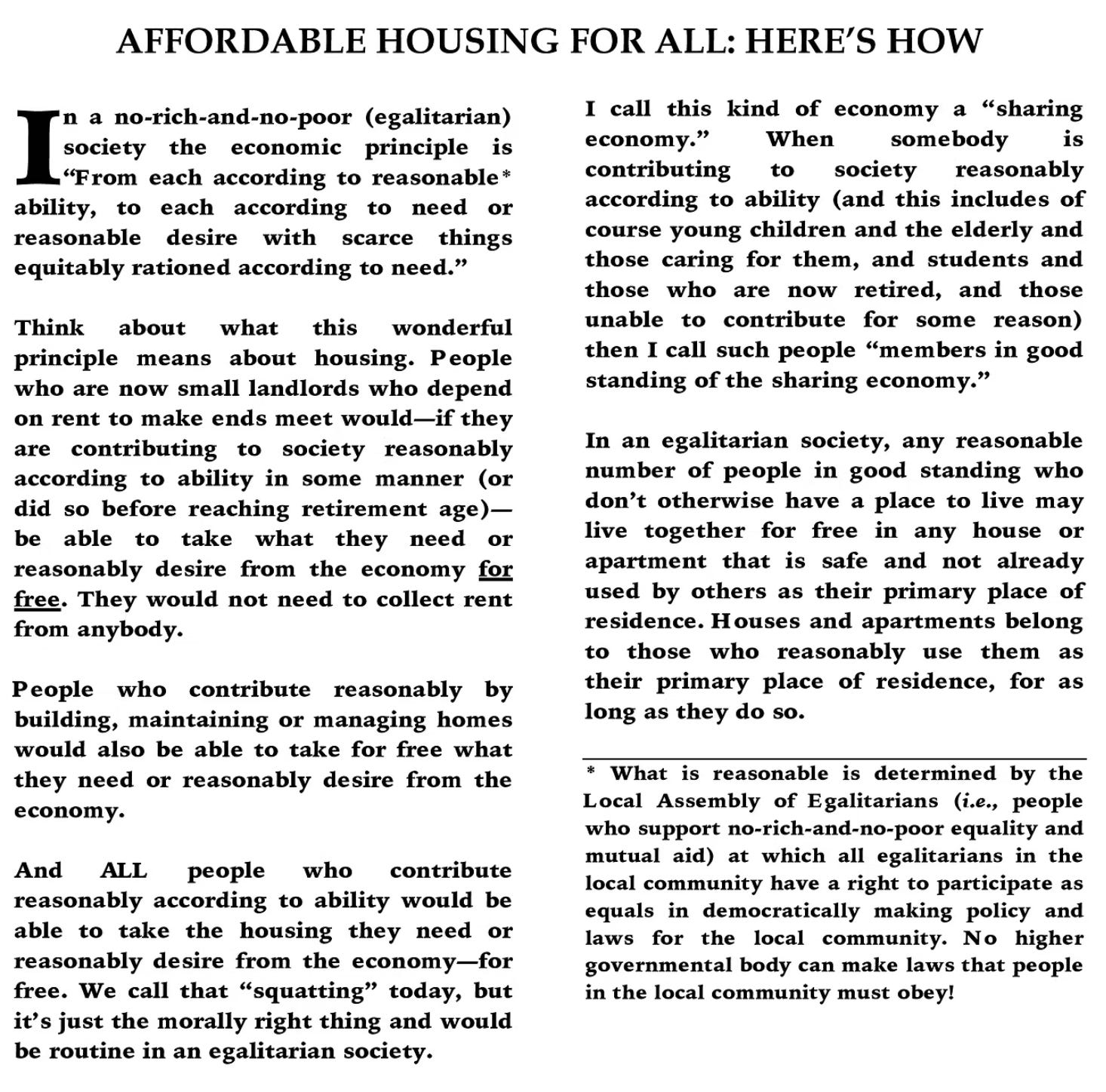
I would not be surprised if the authors of this journal article, like most people, would LOVE an egalitarian revolution. I suspect that the reason their article is silent about the need for an egalitarian revolution is a combination of the following:
They believed (no doubt correctly) that their article wouldn’t be published if it spoke (with whatever wording) about the need for an egalitarian revolution;
They believed (wrongly) that people reading their article would respond to it negatively if they spoke (with whatever wording) of the need for an egalitarian revolution;
They had never heard the idea of egalitarian revolution expressed and so it just didn’t occur to them to express it.
As a result of the ruling class censoring the very idea of egalitarian revolution, the public discourse about the problem of drug users and addicts on the streets of our cities offers us only two policies to choose from: a) harm reduction or b) police repression to “clean up the streets.” Neither gets to the root of the problem. Either choice, when used, eventually creates results that the public doesn’t like, at which point the pendulum swings to the other policy. The result is the public becomes hopeless that there is any solution at all. Hopelessness is exactly what the ruling class counts on to stay in power with its enormous undeserved wealth and power and privilege, as I discuss here.
Thank you for this. I have put off too long to advance an egalitarian argument that all the money that is spent on homelessness be directed into creating an egalitarian commons wherein "homeless" people can find a home and find employment and live according to the principle that each contributes according to his/her ability and take / receive from the commons what they need to live in dignity.
Solving homelessness is not hard; create dignity villages, places where people can live and contribute. The beauty of egalitarianism, as radical egalitarians define the idea is that all work, contribute to society. Presently, capitalist society does not ask this much less demand it. It is a world of each to his / her own. So, no wonder there are refugees (homeless).
But this problem is so complicated that it feels shallow to even take the issue on in a few paragraphs, but the egalitarians, with the golden rule in tow, do have the best ideas for solving the problem. Create an egalitarian commons where the "homeless" can have a home and contribute to society, easy breezy, no brainer, right?
The bigger problem of removing the rich from power can be addressed concurrently with giving the homeless agency to live in dignity. Some of the homeless will respond and take agency and some may too debilitated to engage, sadly.
"The Bible says, “The poor you shall always have with you.” What the Bible doesn’t mention is what a gigantic effort it takes for the rich to keep people poor. Nearly every aspect of life in America is organized to justify and enforce inequality. Human beings are conditioned from the cradle to the grave to accept inequality as the natural condition of human society and accept their place in society as right. Inequality is maintained only at great human cost: by undermining the self-confidence, underutilizing the intelligence, under-developing the talents of the great
majority of human beings, to get them to internalize their status." [From Thinking about Revolution by John Spritzler and Dave Stratman, at https://www.pdrboston.org/_files/ugd/20615e_9412e65c437049878b765875416bcb42.pdf .]